NANCY WAKE – THE WHITE MOUSE
George Medal – Legion d’Honneur – Croix de Guerre (3 times) – Medaille de la Resistance – Medal of Freedom – Companion of the Order of Australia
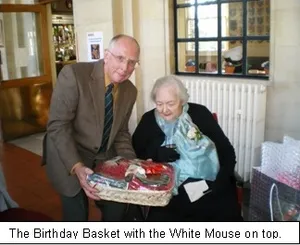
A number of people in the Society will have known Nancy Wake personally. She was a member of ELMS and a great supporter of the Society and its work. Nancy presided over her birthday parties each year, gatherings of a few friends, mainly SOE but on each occasion some ELMS friends too. On one occasion, bereft of any idea about what to take Nancy Wake, I eventually decided upon a wicker basket of preserves, wine, biscuits and fudge. This was all gift-wrapped and I carefully carried it all the way to south London from North Yorkshire by train, without mishap! The day before I left I had visited Eden Camp Museum where I had spotted some white sugar mice, so I had included one on the top of the basket. On seeing the mouse Nancy burst into a smile and said ‘After all these years you still remember!’ The white sugar mouse took pride of place that day.
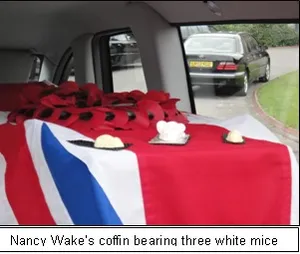
On the 17 August 2011 I again travelled south, this time to say goodbye to Nancy as she made her final Home-Run. I understood that she wanted no fuss at her funeral and had only listed ten people she wanted to be present – five of those were ELMS members. In line with her request, the small group met up. Her coffin was draped in a Union Jack with a single poppy wreath placed on top. I took the liberty of placing two white mice on the coffin. Another gentleman also placed his white mouse.
Nancy Wake, Escape Line courier, French Resistance worker and SOE agent, a free spirit, self-disciplined, fearless, and determined. The Gestapo nicknamed her ‘The White Mouse’ because of her ability to avoid capture and placed a 5 million franc bounty on her head. She was never betrayed. Born in New Zealand, Nancy grew up in Australia. As a young girl she twice ran away from home and later trained as a nurse. Aged 19 she became a journalist based in Paris, New York and London. As a freelance journalist and war correspondent, she interviewed Adolf Hitler in 1933 and attended the mass rallies. That interview changed her life and at that early stage she had decided to oppose Nazism having witnessed them beating Jews in Germany.
In Paris Nancy’s independent spirit and good looks caught the eye of the rich industrialist Henri Fiocca, from Marseille, who she later married. Not averse to a drink or two, she frequented and dined in the luxury hotels in Marseille and Paris and lived ‘the good life’ to the full. When war broke out she trained as an ambulance driver. In 1940 following a chance encounter with a British officer in the Hotel du Louvre in Marseille, she became involved with the Resistance, which led to her courier work with the O’Leary Line where she assisted allied escapers and evaders out of occupied France to the Pyrenees. One of Nancy’s evaders was Sir Lewis Hodges, the first Patron of ELMS. December 1940 saw her flat in Marseille hosting fifteen allied evaders, escapers and other fugitives for Christmas dinner; the group included Ian Garrow, who had an escape route in place (it later became the Pat O’Leary Line). Pat O’Leary escaped from St Hippolyte-du-Fort, was hidden in a convent before arriving at the Fiocca’s home. Although her house became a safe-house for the line and held evaders and escapers, to take the pressure of the house and Henri, Nancy bought a flat for the Resistance which she also used as a safe-house for evaders and men on the run. The Resistance also used it as a base for arms, ammunition and stores.
Operating from her flat, Nancy became a key courier travelling throughout southern France to deliver her parcels (evaders) from Nice, Nimes, Toulon, Cannes and Marseille onwards to Perpignan and the Pyrenees border areas. Nancy also delivered civilian clothing, documents and money. Henri provided the Line with funds. Later when Ian Garrow was arrested it was Nancy who organised his escape from prison. Inevitably, living a very dangerous lifestyle, she was arrested and badly beaten under interrogation for four days, but kept to her cover story and betrayed no one. She was later released through the intervention of Pat O’Leary who, taking a very dangerous risk using an identity card of a senior member of the French Millice, stormed into the prison demanding to see the Commissaire. He explained that Nancy was his mistress, and that he was her lover. The reason why she would not say anything was to protect him from the rage of her husband. The French Commissaire fully understood. O’Leary also explained that he knew M. Laval, and that the Commisaire should release Mme Fiocca immediately, which he did.
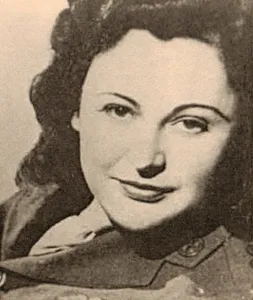
Nancy used her feminine charm to talk her way through roads blocks and other compromising situations. She could usually flirt her way out of trouble. On one occasion, carrying a suitcase of supplies for the Resistance, she stopped to talk to a Gestapo Officer before he had chance to stop her. Her femininity worked well and she cleared the roadblock travelling at the side of her Gestapo escort. Nancy could also be harsh and tough and was reputably able to swear in the French language in the coarsest of terms. Intensely loyal to Great Britain and France she was confident in what she did and felt no guilt.
When warned that the Gestapo were on to her in Paris and Marseille, Nancy quickly kissed Henri goodbye and moved to the safe-house of Francoise Dissart in Toulouse. After five failed attempts to cross the Pyrenees, she was on her way to Perpignan by train along with allied evaders also aiming to cross the Pyrenees, when a railway official dashed in saying the Germans were going to check the train. Without hesitation Nancy jumped from the train window, the evaders hot on her heels. She had just reached a vineyard when gun-fire opened up from the train. The line had been broken again. Nancy had left jewellery and her identity cards in her handbag on the train, along with her walking boots. Luckily she still had money and finding the guides had also gone to ground, and O’Leary was captured, she took two of the airmen and boarded a train to Nice and the safe-house of Mme Sainson. Mme Sainson’s house was a risky choice, she always had a house full of airmen and soldiers, over thirty at any one time. On one occasion when her house was raided her twelve-year-old daughter calmly removed a radio transmitter from the house, placed it in a box of rubbish and took it outside to the rubbish tip right past the Gestapo agents.
Nancy eventually escaped, crossed the Pyrenees after forty-seven hours of hard climbing, and returned to London in 1943. Henri was set to follow but was picked up by the Gestapo. Unknown to Nancy, at the time she was edging towards safety, Henri was being harshly interrogated by the Gestapo in Marseille to find out where she was. Henri was badly tortured, but gave nothing away, and later died.
In England, Nancy was invited by SOE for training and a return to operations in France; she trained and complained. Silent killing, explosives, parachuting, grenade throwing, safe-blowing, early morning runs, long distance marches and map reading were not for Nancy, but she completed the course despite a number of arguments with the directing staff and missing many of the early runs because she felt unwell !! On one occasion, when caught drinking, Nancy was dismissed from the course and asked to return her FANY uniform. However, through the intervention of Ian Garrow and a former evader who she had hidden in her Marseille flat and was now a Colonel in the SOE, she returned to training, where amongst her many friends was Violette Szabo.
On 29 April 1944, now holding the rank of Captain, Nancy was parachuted back into France, into the Auvergne near Montlucon, together with another agent. Amongst her equipment that night were two French nightdresses and cosmetics. Throughout her life in the field she always tried, each night, to change into a nightdress. Later when working with the Maquis she insisted that amongst the weapons and ammunition dropped to her were silk stockings and Elizabeth Arden face cream!
Nancy’s new task was to work with and coordinate the Maquis, causing as much trouble as possible in the lead up to D-Day. Initially the French would not deal with her and only wanted the money that they thought she had. After a number of meetings, conferences and drinking sessions, where she proved she could hold her drink better than they could, she informed them that she was chef du parachutage and would only arm them and pay them when they had proved they were up to the job, became more disciplined, and developed a strategy and plan. She had arrived with a handbag full of money and a pistol, and one month later was the leader of the Maquis d’Auvergne. No sector in the whole of France caused the Germans more trouble. Nancy led from the front and took part in ambushes, sabotage and raiding parties.
On one occasion her position was attacked with the intention of obliterating the Maquis base on the plateau above Chaudes-Aigues. Over 22,000 German troops had gathered in the local area supported by artillery, field guns, fighter aircraft and heavy weapons including machine guns and mortars. The Maquis were surrounded and a conference of all group leaders was hastily convened. The Maquis wanted to fight to the death but were convinced by Nancy that they should fight a withdrawal action to enable them to fight another day. (Only one group defied the order.) With a force of only 500 who were heavily out-numbered and lightly armed they were not equipped to take on a pitched battle with battle-hardened troops supported by heavy weapons, armour and aircraft. During the ensuing battle Nancy visited each sector and Maquis to deliver ammunition and reassure. Her radio operator, Denis Rake, had opened ‘comms’ with London and informed Nancy that all had to carry out a fighting withdrawal under the cover of darkness. The order had come from General Konig who was with the Free French in London. Nancy immediately visited all the sectors and positions to relay the order. On several occasions, while delivering the message, her car was attacked by enemy aircraft. In one incident two aircraft came in low forcing them to flee the car and take shelter in a ditch. The car was raked with bullet holes. The Frenchmen got up to run but were held back by Nancy. She made a dash for the car, wrenched open the door and grabbed a parcel just as the aircraft returned. The car burst into flames as she returned to the Frenchmen. ‘I needed these,’ she said and opened the box that included face cream, a red satin cushion, tea and other personal items. The Frenchmen could not believe what they saw and considered her to be completely mad.
The Maquis had a difficult withdrawal and took many casualties. They lost 107 dead and about the same number wounded. The fact that the Maquis were able to withdraw was due to Nancy’s planning and insistence that each contact with the enemy must have escape routes. The Germans lost 14000 dead. In all sectors the enemy had been drawn into entrapment and then destroyed, with the Maquis withdrawing immediately after each battle. During the desperate withdrawal from the plateau Denis Rake had destroyed his radio codes and buried the radio – they were no longer in contact with London. Unable to locate a radio operator in the area Nancy decided to cycle the long journey to Chateauroux to try and find one of Rake’s contacts. She cycled over 500km in less than 72 hours to find a radio operator and report back to London. Although living rough, each day Nancy ensured her clothing was neat, clean and tidy, to make it appear that, if stopped, she had just cycled a short distance. She also carried cosmetics and had a string shopping bag on her handle-bars. On her return after her marathon cycle ride she was unable to walk or even get off her bicycle!!
After D-Day, the Maquis carried out numerous raids and sabotage attacks on German installations, rail junctions, telephone communications and many opportune targets. Now joined by a Spanish Maquis, with a good knowledge of explosives, they also blew bridges across the main rivers. The Spanish provided Nancy with drivers and bodyguards. One of the chosen targets was the local Gestapo headquarters at Montlucon that caused particular problems for the Resistance and the local population. Nancy had chosen 1225hrs for the raid. At that time, with perfect German punctuality, the Gestapo would be gathering for their meal at 1230. At 1225 Nancy, together with French and Spanish fighters, leapt from four cars, dashed into the building and cleared each room with grenades and machine-gun fire both upstairs and down, and within thirty seconds were back in their cars and away. Many Gestapo were killed.
By the end of September 1944, the war had effectively ended for Nancy and her Maquis fighters. The White Mouse was highly respected by the 8,240 Maquisards, (18 Groups) she commanded. Many were offered the opportunity to join the Allies and fight in uniform. Otherwise they were free to return home. Nancy returned to Marseille to deal with Henri’s estate, most of which had been stolen by the Gestapo including all of their expensive furniture (the flat had been used by women serving in the Marseille Gestapo). Promised reparations of over F5,000,000, Nancy received almost nothing (£70). Soon after VE Day she heard that Pat O’Leary was on his way to Paris from Dachau and not well. He had been severely tortured and treated badly in the prisons and concentration camps. Nancy met him in Paris and for nearly a month nursed him back to reasonable health. She then returned to Marseille. Nancy had worked with the resistance in 1940 and was there still in 1944, she knew the people and shared their attitudes and their sorrow.
On returning to Paris Nancy worked with O’Leary on the Awards Bureau and confirmed with him that the man who had betrayed the Line, and O’Leary himself, had in turn been executed by her Maquis. A later job with the Foreign Office brought Nancy into contact with many of her former Resistance comrades. On one occasion while having a conversation in a bar in a hotel in Paris, the barman left the bar and frantically ran up and kissed Nancy. The manager reprimanded the man asking why he called her the wrong name and why he kissed his clients. The man excitedly explained that ‘This is Mme Andree, she was in the Resistance with me, she liberated Vichy.’
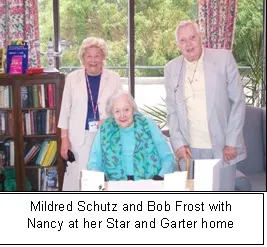
In 1949 Nancy left the FO and worked her passage as a nurse on a ship to Australia where she attempted to enter politics, but was unsuccessful and returned to London in 1951. Later she worked for British Intelligence, until 1957 when she again moved to Australia and married a former fighter pilot, John Forward. On Forward’s death Nancy returned again to London. There she could be found in the Stafford Hotel, then owned by Louis Burdet a Resistance friend from the South of France, where she had her own leather bar-stool at the end of the bar and where she could drink her gin & tonics. Nancy Wake never really adjusted to a peacetime world. In later years Nancy moved to a Star & Garter Home. She had no entitlement to British pensions and always made her own way in the world. Apparently she sold her medals to make ends meet and commented on the medal sale saying ‘When I die I will go to hell and they will melt anyway!’
‘When I die, I want my ashes scattered over the hills where I fought with brave men’.
Nancy Grace Augusta Wake died on 07 August 2011 aged 98. According to her wishes, Nancy’s body was cremated privately at a small gathering of chosen friends. The service finished with her chosen music – ‘The Chant of the Partisans’ and ‘Non, je ne regrette rien’. A Memorial service was held later for Nancy’s many friends and comrades to pay their respects and remember her remarkable life.
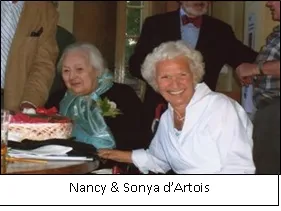
Sonya d’Artois, a lifelong friend who trained with Nancy and also dropped into France for SOE, described Nancy as ‘Very feminine, but as tough as any man.’ A Resistance friend also described her as ‘The most feminine woman I know until the fighting starts, then she is like five men.’ Another Resistance veteran said, ‘I do not know what effect Nancy had on the Germans, but by God she frightened me!’
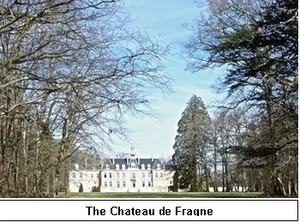
As it had been Nancy’s wish for her ashes to be scattered at Montlucon in central France where she fought in the heroic attack on the Gestapo Headquarters, on the 10th March 2013, a small group gathered in that beautiful area of the Auvergne to say a final farewell to Nancy Wake and to scatter her ashes in the woods surrounding the, now privately owned, Chateau de Fragne on the outskirts of the village of Verneix, near Montlucon, which had served as Nancy’s HQ with the Maquis in 1944. Martyn Cox, represented the Escape Lines Memorial Society and laid an ELMS wreath at the ceremony in the woods, but following the service the wreath was taken from the private Chateau grounds and relocated on the Resistance Memorial at Montlucon as a public display of recognition for Nancy Wake. The Mayor of Montlucon announced that later in the year a plaque would be installed in the village in memory of the local Resistance and Nancy. His point being that the grounds of the chateau are private land but the plaque in the village will be there for all to see. Although heavy thunder-storms had been forecast, the rain held off and the sun shone throughout until the ceremonies were over. The first raindrops fell as the group were walking in for lunch, so maybe Nancy had been on the case all along!! Perhaps Nancy’s spirit can be summed up by her reputed choice of ‘Code Poem’:
She stood right there, in the moonlight fair, And the moon shone through her nightie…………….
Apparently it had quite a saucy ending! However besides her courage and spirit of adventure Nancy was also a very wise and observant woman; to quote from her autobiography:
“I already knew the horrors a totalitarian state could bring and long before the Second World was declared, I understood that the free world can only remain free by defending itself against any form of aggression.
I knew too that freedom could not be permanent. It has to be defended at all cost, even if by doing so part of our own freedom has to be sacrificed.
Freedom will always be in danger because, alas, victory is not permanent.”