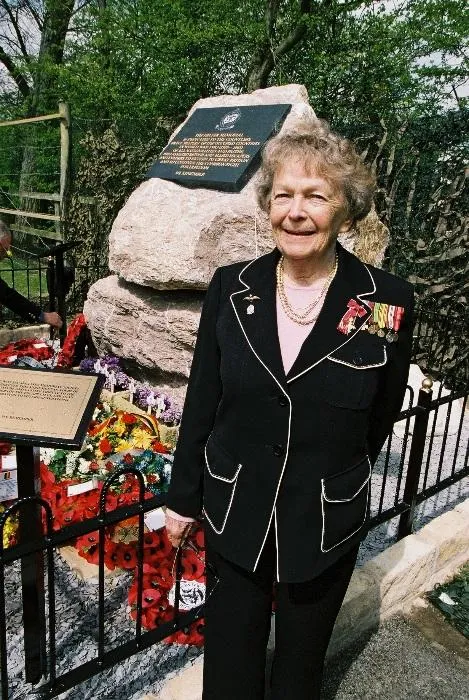
Lieutenant ARA SRA ‘Luc-Marc’ & Comète Officier de Ia Ordre de la Couronne – Officier de l’Ordre de Leopold II – Chevalier de l’Order de Leopold, avec palms, et deux glaives croises – Croix de Guerre 1940 avec palme – Croix de Prisonnier Politique de la Guerre 1940 – 1945, avec 6 etoiles – Medaille de la Resistance – Medaille Commemorative de la Guerre 1940-45 – Medaille du Volontaire de Guerre Combattant 1940-45 – Medaille du Militaire, Combattant de la Guerre 1940-45
Officer of the Most Excellent Order of the British Empire – Kings Medal for Courage in the cause of Freedom – Medal of Freedom, with Bronze Palm.
Nadine, as she was affectionately known to all, was a member of an exceptional ‘Helper’ family’. She agreed to join ELMS and became Number 4 on the nominal roll, going on to support our events in England and Europe for the rest of her life.
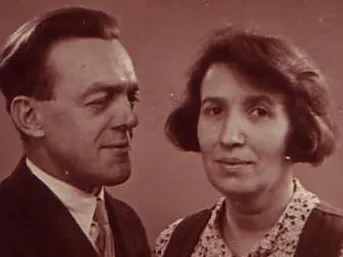
Nadine was born in Brussels on September 5 1922 and, as a child, spent her early years in the Belgian Congo where her father was a doctor and her mother a nurse. Later, returning to Brussels, she was educated at the Royal Athenaeum in Uccle. As a young student, together with many other Belgians, she was shocked at the capitulation of Belgium when the Germans invaded in May 1940.
Nadine’s Story – In her own words
In 2011, Nadine was asked if she would write a few words about her war-time life. As always, what she wrote was very unassuming – she was very modest about her part!
Nadine spoke French as her first language, but she kindly wrote in English for us. However, she acknowledged that her translation would need a little ‘tidying-up’, and wrote:
“Please take this and place things right. If you don’t understand don’t hesitate to say it.
Kindest Regards, Nadine.”
This, in her own words, [with only a little ‘tidying-up’] is Nadine’s Story:
Here in short, my story:
When the Germans invaded our country, a lot of people decided to leave for France: after talking together we decided to stay.
So we saw the English and Belgian soldiers go by at the bottom of our street, going to fight the enemy. A few days later, we saw them coming back!
Then there were many prisoners, English and Belgian. They stayed in an open-air camp near us: we decided to collect food and clothes and I went on a bicycle to throw it over the walls of the camp. Very soon they were sent, to Prisoner of War camps in Germany, but some of them escaped first and were taken by people into their houses.
Then we decided to do what we could against the occupation army!
There were many injured soldiers who were taken care of by the Red Cross. My father, as a doctor, my mother as a nurse and my sister as an ambulance assistant were working with the Red Cross. Soon my mother heard that some of the English were staying in ‘safe-houses’; so it was necessary to find a way to get them to England.
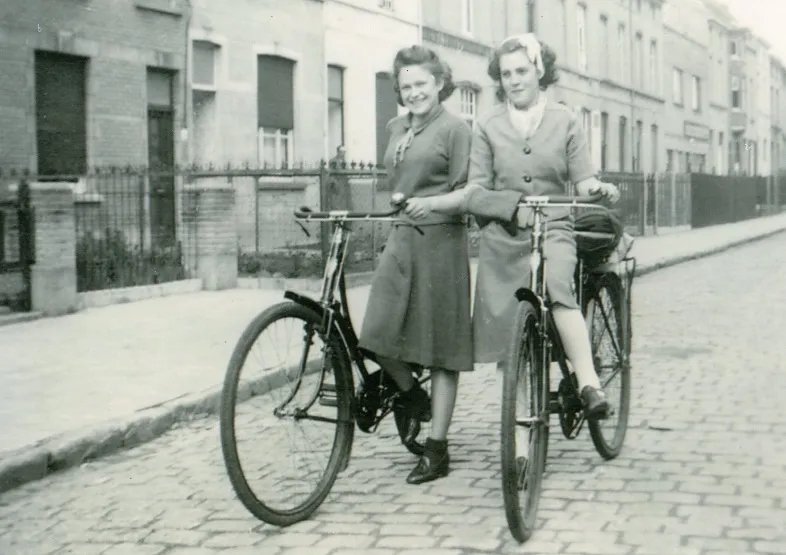
Nadine and sister Michou
Using my bicycle, I delivered to the letterboxes of people a lot of things against the Nazis [I received them from my parents]. Also, I cut a lot of ‘V’ shapes from paper, and scattered them in the streets while riding my bicycle. [I can say that six-months later, there were still ‘Vs’ in the streets!]
Later, my mother had contacts with ‘Libre Belgique Clandestine’, so I proposed to take a parcel of the publications and also put them through letter-boxes – always using my bicycle, of course! Soon, I received a great number of addresses to deliver to, so I learned the addresses by heart, and every month or so, I continued to distribute them.
Then my father was put in contact with somebody who also wanted to help the cause, and very quickly he met a military student who had to be hidden – he found a dwelling at our house. So the three of them put in place the beginning of an information service, and the boy gave a lot of names of other students who also wanted to be involved. Some of them were to become couriers for my father, who very soon was in contact with the leader [in that time] of the ‘Service Luc!’
In the meantime, my mother was in touch with Monsieur De Jongh. He came to our house one evening and asked me if I wanted to help him because, as he was headmaster of a school in Schaerbeek, he did not have much time. I was very happy [because when you begin to do something you always wish to do more.]
My father very soon became the ‘right-arm’ of the leader Pierre Depreter [both of them didn’t come back from the camps – Depreter was shot – as was so for many others.] It’s for that, that they don’t speak much about them.
So, we became more and more involved in the resistance! My job for Mr D.J. [De Jongh], began in Brussels – looking for false papers, carrying messages, finding clothes and shoes…….. Then, at the end of December ’41, he asked me if I wanted to go to Valenciennes, and there I met Charlie Morelle, and then we went to Feignes to meet Dédée, Mr De Jongh’s Daughter – she arrived from Paris with Elvire Morelle. I was very proud to meet Dédée – she was bright and smiling and so dynamic, I was under her charm! All our lives we stayed very good friends!
Then, alone, I took Al Day to Valenciennes. After that I went, alone, to Paris, with one, two or three ‘boys’ [evaders] at a time. Suddenly, Mr De Jongh had to go to Paris, because the Germans were looking for him. [At that time he had been staying in Uccle, in the house of some cousins of my parents. On one occasion, a man – who was a chief of ‘The Beaver Service’ – had arrived at our home asking for the address of Mr de Jongh because he had something important to tell him, but luckily I refused to give the address, because later the man was arrested and told the Germans everything he knew!]
Suddenly, my father was looking after a lot of airmen, and we had lost contact with Mr De Jongh. So I told my parents that I was going to Paris to search for him. I spent all day searching, and finally found him. He was happy to see me, but requested that I go home and quickly return with more ‘boys’!
After several trips going back and forth, I arrived back very early in the morning, but encountered a friend of my father who wanted to know why I was out on the streets at that time. I lied that I was going to the early market in the centre of Brussels [Ouch!!]. Then I went home and slept all night and most of the next day!
We were arrested on the11th August 1942, my parents and I. My sister, to whom my father had entrusted some information, contacted others so that they knew not to attempt to make contact. Little by little my sister continued our work; not much in the beginning because she was still studying nursing, but by 1943 she had finished her studies and found herself a safe-house. Then she became more involved – first in Brussels, then she had to escape to Paris, where she continued.
What Nadine did not tell – in her own words – was what happened to her and her family after she was captured, she did not dwell on it:
She was arrested together with her parents [betrayed by a collaborator known as ‘Coco’]. ‘Michou’ [her sister], still free, took over Nadine’s job on the line and continued to move evaders. The Gestapo mistakenly thought that they had captured Andrée de Jongh, the leader of Comète, as they both had the name of Dédée, and were similar in size.
Nadine was treated very badly in the Prison of St Gilles and interrogated daily for twelve months, by the Gestapo. Finally, when the Germans decided that they would get no information from her, Nadine was moved to Germany under the ‘Nacht und Nebel’ order – to ‘disappear’ into the prisons and camps system, lose her identity and have no further contact with anyone. Between 1943, and the spring of 1945, Nadine was held in five prisons. Then at the Gross-Strehlitz Camp she met a Resistance friend and they saw an opportunity to escape. They escaped, but were spotted by a farmer who reported them and they were captured and taken back to the camp. Nadine then suffered the appalling conditions of Ravensbruck concentration camp for women, north of Berlin. From Ravensbruck she was later moved to Mauthausen in Austria.
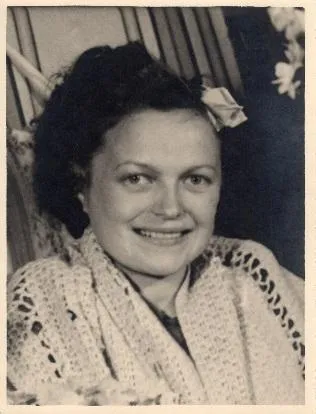
On her release from Mauthausen at the end of the war, Nadine was very ill, infected with typhoid fever and paratyphoid. Her mother had been released a year after her own arrest, but her father, Eugene Dumon had been murdered in Gross-Rosen concentration camp on February 9th 1945. When Nadine’s mother met her at Brussels station they had difficulty recognising each other. Nadine spent the first three months of freedom in hospital and took another two years to recover. Following her medical treatment, one of Nadine’s ‘boys’ [evaders], Les Baveystock, who had travelled to Europe to search for his helpers, invited Nadine to his family home in Australia for six months to recuperate.
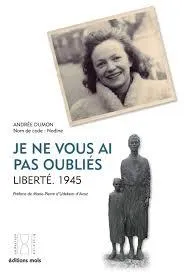
After the war Nadine married Gustave Antoine, who had worked with the Belgian Resistance; they had a family and began a successful textile business. In addition, she worked tirelessly for recognition and compensation for the people who fought in the Resistance and on the Escape Lines. She also ran the annual Comète Reunion in Brussels with members of the Royal Air Forces Escaping Society then, for a while, from 1995 following the closure of the RAFES, with the WW2 Escape Lines Memorial Society, and latterly with Comète Kinship. Nadine was active in her work for RUSRA-KUIAD, spreading the word of peace, freedom and democracy, by being involved in debates, lectures, school visits, exhibitions, TV documentaries, newspaper articles and interviews. She even published her memoirs as she approached her 100th birthday.
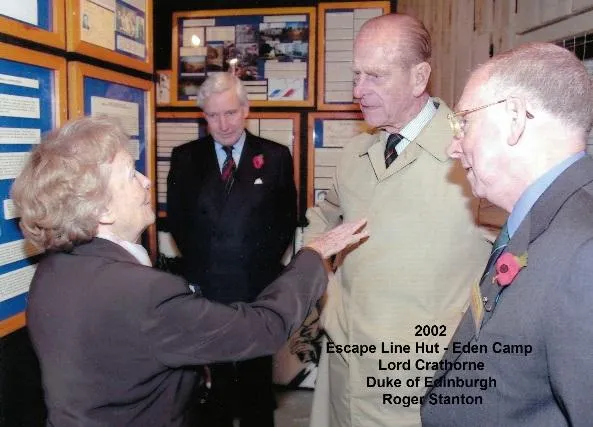
Nadine was a loyal supporter of the RAFES, ELMS and the Comète Reunion in Brussels, of which she was Secretary, and she was instrumental in the emergence of Comète Kinship, now Comète Remembrance. In 2002, Nadine was introduced to HRH the Duke of Edinburgh during his visit to the Escape Lines display at Eden Camp. In 2010 during the 70th Anniversary of De Gaulle’s ‘call to arms’ commemorations at the Royal Hospital in Chelsea, she was introduced to British Prime Minister the Rt Hon David Cameron and to the President of the French Republic, His Excellency Nicolas Sarkozy.
Until the last few years Nadine supported all ELMS annual events in York and London and also attended many of our events in the Pyrenees, and all the events in Brussels. At each of these events she generously gave her time to talk to students, and throughout her life she remained in contact with many of her ‘parcels’ – her ‘boys’.
Andrée Dumon was born on 05 September 1922 in Brussels. She died 30 on January 2025 at Nivelles, age 102.