2006 - Comete Trail - P Douglas
Following the Tail of Comète - [2006]
As a ten year old, Phil Douglas was captivated by the BBC television drama series ‘Secret Army’ about a secret escape line in WW2. Years later he chanced upon some ‘repeats’ which whetted his appetite to find out if there was any truth in the series. On discovering that the series was based upon a real escape line – Comète – Phil began serious research. He started with the book ‘Little Cyclone’ by Airey Neave and then began visiting Brussels to find the locations associated with the Comète Line. In the Koekelberg Basilica he found a wreath, which had been laid by ELMS at the Comète stained glass window in the RAF Chapel. So, Phil joined ELMS and embarked upon his first ‘Comète Trail’!
Rather than travel direct to St Jean de Luz, Phil decided to follow in the footsteps of the Comete couriers, starting his journey in Brussels.
On Friday the 01 September I spent the day visiting many locations in Brussels including the de Jonghs former home in Ave Emily Verhaeren, the building that housed the Swedish Canteen that became Comet’s headquarters in the Rue Ducale, and Nemo’s grave in Zellick.
The next day I left Brussels by train to the Belgian border town of Quievrain. The station is all boarded up now; the train does not now run to Valenciennes, so I caught the bus.
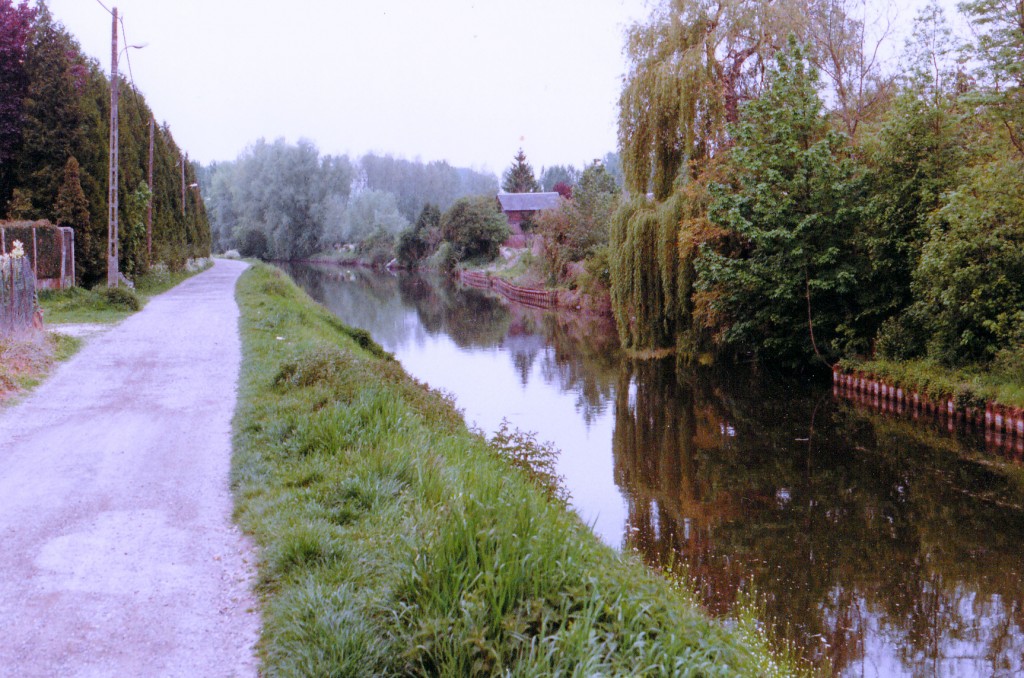
On day three, en-route to Corbie, I broke my journey at Arras, and took a day out to remember the sacrifice two of my uncles made during the Great War where they lost their lives, and to learn a little about the conditions they must have endured by making a tour of the local battlefields, which ended with a visit to Thiepval.
At Corbie on the River Somme, I stayed overnight, and took a small stroll at night to the south side of the river to the hamlet of Hamelet. I had set myself the mission of trying to find the safe-house where Dede and her evaders rested after the crossing of the River Somme. I knew that it was owned by a lady called Nenette. I did not hold much hope of finding it, but after several enquiries, the house was finally pointed out to me by an elderly lady walking her dog. Although Renee Boulanger (Nenette) died in the eighties, her daughter and granddaughter were still living in the same house. A very pleasant hour was spent talking to Nenette’s daughter, Jean Skibinki about her memories of the evaders that would arrive after nightfall and leave early next morning.
The following morning I walked as Nenette’s evaders would have done from Hamelet to the railway station at Villers Bretonneux, before catching the train to Amiens, and on to Paris Gare de Nord. Looking up at the station’s great arched roof, I remembered that it was here that Frederick de Jongh, and his friends Robert and Germaine Ayle were betrayed to the Gestapo while waiting to guide a group of evaders across Paris. I now found a map, and visited Rue Oudinot and Rue de Babylone where Dédée and her father Frederick de Jongh made their Paris headquarters.
Next it was the Gare d’Austerlitz, and the overnight train to Irun. For Dédée, this must have been a major worry. Gestapo and plain clothed police were all over the station. As dawn broke, I awoke, and left the train at Bayonne to find the station café in which Operation ‘Water Closet’ was carried out by ‘B’ Johnson and Janine de Greef to avoid having evaders passing through the ticket barrier. Although the station had been renovated, I found the station café, and the Gents, with the side door through which the evaders would emerge to be greeted by Tante Go, who would be sat in a café opposite the station. From here the evaders would now make their way to St Jean de Luz by cycle. I now made my way to the Villa Chagrin, the prison in which Dedee was first kept after being arrested in Urrugne. Arriving in St Jean de Luz on Wednesday, I explored this delightful fishing town, but could not wait to meet up with other ELMS members and start the final journey over the Pyrenees.
On the Thursday I spent time chatting with ‘helper’ Andre Dumont (Nadine), at breakfast in the hotel. Other members arrived during the day, and a pleasant evening was spent in one of the many roadside restaurants enjoying a wonderful meal and a few drinks with members.
Friday was official receptions, starting at St Jean de Luz War Memorial, which was followed by a reception at the Marie hosted by the Mayor. Although made very welcome at the Marie, I thought it ironic that the reception was held above the very cell that Andree de Jongh had spent her first night in captivity after being arrested in Urrugne. The Marie being above the Police Station. During the afternoon we were driven to Bayonne and Anglet, and the former home and safe-house of the de Greef family, before attending a wreath laying at the Anglet War Memorial with Resistance members, followed by another wonderful reception. Early evening and we were on the move again to Urrugne, and another splendid meal organised by our Basque friends. I now felt I would not need to eat for a week.
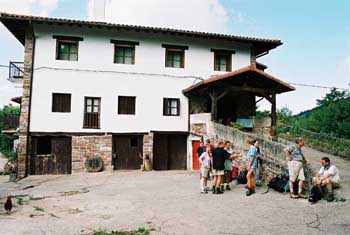
Saturday started with the laying of wreaths on the graves of Kattalin and Florentino at Ciboure, after which our memorial walk began. I had been warned over the previous couple of days that I may find the trek difficult, but to be honest, until we reached Francia’s farmhouse at Bidegainberri, I found it rather easy. I now looked up at the mountains around us and realised that they were our goal. From here the real walk began. Until now I had kept up a good pace, but soon, the frequent breaks I took to get my breath landed me amongst the stragglers. The weather did not help. A blazing sun and temperatures in the thirties sapped my will to continue, together with my distinct lack of training made every step an agonizing chore. I now questioned the wisdom of embarking on such a trek, I continued, eventually hearing the sound of the River Bidassoa, and after wading through icy cold water, reached Spain and the welcoming smiles of our veterans and helpers, and bottles of water.
On Sunday I awoke feeling fresh and full of energy, but within ten minutes of starting our second days trek, all up hill, tiredness had returned, and I was again gasping for breath. I did not think anything would be as hard as the trek on the Saturday, but if anything Sunday was worse. A heartfelt thanks must go to our Basque guides who kept me going to the farmhouse at Sarobe, with the infamous ‘just 200m more’.
The journey from Brussels to St Jean de Luz was a great experience. To visit the safe-houses and locations of Comète brought Comète alive. To re-trace the steps evaders took between St Jean de Luz and Sarobe farm, although difficult, and at times painful, was an honour and a privilege. Fellow walkers like myself undertook this trek during daylight, in good weather, and over two days. How the evaders, together with Dedee, Franco, and Florentino ever completed the entire journey in one go, in darkness, and in all weathers will never fail to impress me.
The warmth and loyalty of our hosts, and the friendships made with everyone from ELMS combined to make this one of my most enjoyable holidays to date. But my overriding memory will be the quality time I was able to spend listening to the stories of the veterans and Andree Dumont.