2002 - Comete Trail - E Harrison
1992 – 2002 - Tenth Anniversary of all HOME-RUN CHALLENGES
The Comète Memorial Trail - September 2002
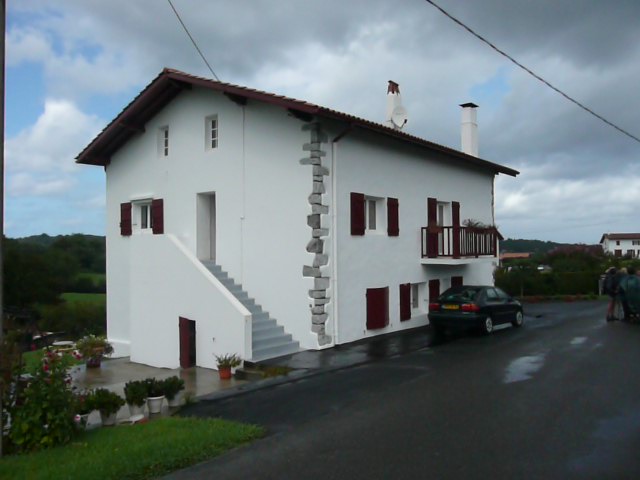
In a number of books about the Comète Escape Line you may have noticed the faded photograph of Francia Usandizaga, the Basque widow and mother of three young children, and of her isolated farmhouse near Urrugne, in the Pyrenees close to the border with Spain. It was here, on 15 January 1943, that Dédée De Jongh, Francia and her Basque farmhand, together with three RAF evaders, Stan Hope, George Ross and Bill Greaves, were arrested by the Nazis. The airmen ended their war in German Prisoner of War camps but the three civilians were deported to concentration camps - only Dédée De Jongh survived.
And there we were on 14 September 2002, in the courtyard of poor, courageous Francia’s house, enjoying a copious lunch laid on by the present owners. Sixty-seven walkers, among them Francia’s daughter Marie, only nine years old when her mother disappeared to Ravensbrück, together with Marie-Christine and Beñat, grandchildren of Kattalin Aguirre, another of the moving spirits of this end of the Comète Line.
The oldest of the walkers were Paul Broué, a 79 year-old passeur from Seix near St Girons and his wife Marie, and the youngest just 17. We ‘non-walkers’ were led by Nadine (Andrée Antoine-Dumon, OBE), accompanied by Lulu Dassié, herself a helper and survivor of Ravensbrück, André de la Lindi, son of Belgian agent Paul Henry, and his wife Lydie, and Kattalin Aguirre’s high spirited daughter Fifine, mother of walkers Marie-Christine and Beñat. From Great Britain there were Gordon Mellor, Maurice Collins and his wife Dot. Sixty years earlier almost to the day, Gordon had been hidden on the first floor of this very house whilst Maurice had walked into Spain via Andorra just a few months later. Both veteran RAF evaders from enemy occupied France had crossed these mountains to fight another day. Then there was myself - formerly secretary of the RAF Escaping Society that had been founded at the British Embassy in Paris on 15 September 1945, the fifth anniversary of the Battle of Britain, persevering with its charitable work for 55 years until the end of the last century.
Who can guess what thoughts, what memories, were going through everyone’s minds?
Warm camaraderie and adrenaline were in parallel flow, the whole atmosphere between walkers and non-walkers, British, French, Belgian, American and Spanish, competing with the perfect weather. We laid wreaths at the graves of Kattalin and of Florentino, the most famous ‘passeur’ of them all: his last surviving brother was there, on his 85th birthday. We met many local veteran helpers, their children and grandchildren; among them were Yvonne Lapeyre (who made an impressive speech at the end of our last meal together) and her husband Robert, both key helpers in the Comète network. Guy Barletta, a Frenchman living in Biarritz, always a great help in the planning of these annual events, had welcomed us at Biarritz airport: he had joined the RAF in 1940 - in Singapore! - a faithful member of the RAF Escaping Society who had been shot down over his own country, evaded capture and escaped into neutral Spain like so many others.
The walkers left the cemetery at Ciboure and headed towards Urrugne where we met up again at the town hall for a wreath laying ceremony and where refreshments had been arranged. Then the walkers continued to Francia’s farmhouse at Bidegainberri and more food and drinks appeared. Our next meeting with the walkers was late afternoon at the crossing point of the River Bidassoa. Eight non-walker veterans were crouched on boulders beside the fast flowing river. At about four-thirty the first walkers were seen scrambling down the steep, densely wooded hill towards the river from the French side. Most walkers stood for a moment to take stock of the situation. Boots were removed and in most cases trousers came off too, then espadrilles or the modern equivalent put on to protect the feet from the rocky, river bed and, to the cheers of the non-walkers, the crossings began.
Amongst the walkers was Scott Goodall, taking his time crossing with a Union Jack tied to his walking stick, held high as he crossed the river, carefully wading waist deep without his stick for support to an explosion of laughter, pride in achievement and delighted applause. After the crossing there was a never ending supply of cider, with local supporters cutting dozens of baguettes and grilling several hundred fat sardines to welcome the walkers after their safe arrival in Spain - there was plenty for everyone. As in WW2, the main obstacle had been crossed and the walkers were now in Spain.
Later that evening we returned to St Jean de Luz leaving the walkers in Spain. We met up again late the next day when they arrived at Sarobe Farm, the former first safe-house in Spain for the Comète Line evaders. After a short stop the walkers continued on to Renterria, the Town Hall and then a traditional Basque restaurant for the final celebrations. Walkers and veterans signed the Freedom Trail visitors’ book as the Basque walkers sang their traditional songs for their appreciative guests and toasts and promises were made for the following year
True memorials need not be made of bronze or stone. This trail is a ‘living memorial’ to the helpers and their evaders.